Post / Jul 16, 2025
A CTO’s View on AI Regulation: Canada’s Second Chance for a Competitive Approach
A founder and CTO’s case for interoperable Canadian AI regulation that protects safety without duplicating the compliance burden on startups.
Historical context (July 2025): This article reflects the Canadian policy landscape after Bill C-27, including AIDA, died on the Order Paper in January 2025. Policy work continued after publication, including the September 2025 AI Strategy Task Force. The cost ranges and scenarios below are illustrative author estimates, not findings from a formal cost study. Verify current laws, guidance, and implementation costs before relying on them.
After AIDA’s demise, our next AI law must prioritize cost-effectiveness and harmonization to foster Canadian innovation.
As the co-founder and Chief Technology Officer (CTO) of Adauris.ai — a startup recognized by ALL IN AI as one of Canada’s top 100 AI companies in 2024 — and in my subsequent work as a fractional CTO, my goal has always been to build great innovative products that can compete in the global marketplace. This experience gave me a firsthand view of both the incredible potential within Canada’s tech sector and the real-world barriers that hold it back. But a significant and growing portion of my work — and that of my peers — involves navigating a complex web of compliance requirements that can be incredibly costly, especially for startups who are competing in an already highly competitive marketplace.
The recent demise of the proposed Artificial Intelligence and Data Act (AIDA) in early 2025 provides a critical second chance to get future AI compliance right.
My background is not just in code and computer science — I also studied political science. I understand and support the need for guardrails to ensure safe and ethical AI.
As we look toward future AI legislation, our national goal must be twofold: ensure AI is safe, and do so in a way that lowers the barrier to entry and reduces the cost burden on our innovators. A bespoke, “Made in Canada” AI law risks achieving the opposite by creating a duplicative cost layer that stifles startups and hinders our national AI competitiveness and productivity.
A practical path to a competitive AI ecosystem is smart international regulatory harmonization — a strategy that is not only effective but fundamentally more cost-efficient.
The Existing Compliance Stack
To understand the problem, we must first quantify the burden Canadian innovators already carry. Before a single line of AI-specific law is written, a scaling startup must navigate a multi-layered “compliance stack.”
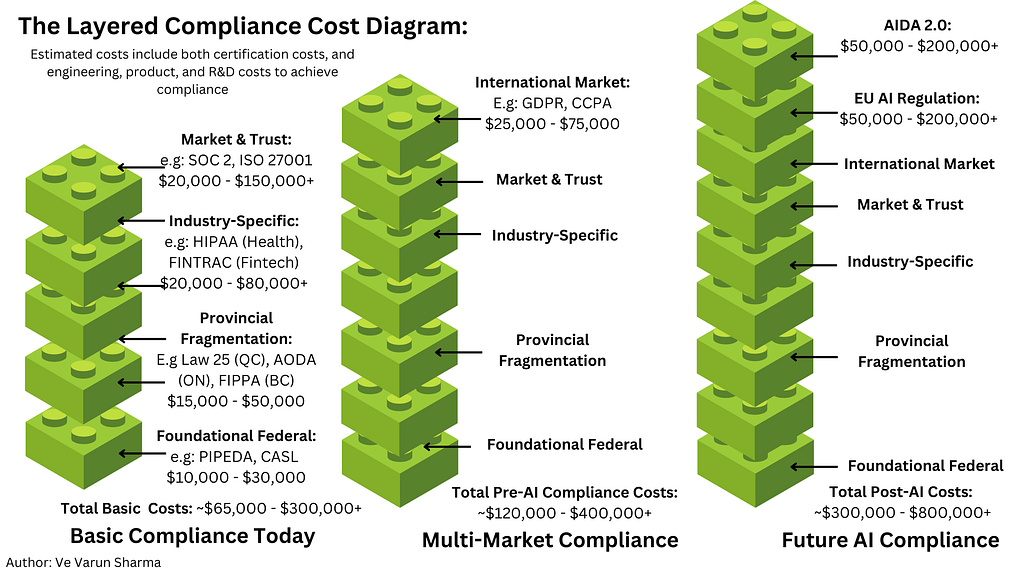
- Layer 1: Foundational Federal Rules: The baseline for any Canadian tech company includes adherence to PIPEDA (privacy) and CASL (anti-spam).
- Layer 2: Provincial Fragmentation: We must then dedicate legal and engineering resources to navigate a patchwork of provincial laws, such as Quebec’s Law 25, Ontario’s AODA accessibility standards, BC’s FIPPA, and Alberta’s Protection of Privacy Act and Access to Information Act for public-sector privacy and access.
- Layer 3: Industry-Specific Mandates: For companies in regulated sectors, the stack grows when those obligations apply. Health-tech organizations handling Ontario health information may have PHIPA duties; financial businesses may face FINTRAC requirements when they are reporting entities, while PCI DSS is a contractual payment-card standard.
- Layer 4: Market-Driven “Trust” Audits: To be taken seriously by enterprise customers, startups who want to secure larger customer enterprise deals must undergo voluntary but essential attestations like SOC 2 or certifications like ISO 27001. These assurance programs are market requirements that demonstrate security and can cost a startup up to six figures.
- Layer 5: Global Market Access: To sell outside Canada, startups must comply with international standards, primarily the EU’s GDPR and California’s CCPA/CPRA to name a few.
Each of these layers can require significant investment in legal counsel, engineering time, and specialized tools, diverting resources directly from product development, R&D, hiring, and other essential work that moves the needle for startups.
Quantifying the Burden: The Pre-AI Compliance Tax
The following figures illustrate how cumulative compliance costs can grow across organizations. They are directional scenarios rather than measured industry averages; actual costs vary materially by company size, sector, market, and scope.
Illustrative cost model: The original article included “The Pre-AI Compliance Innovation Tax Cost Breakdown.” Its ranges were author-created scenarios, not measured industry averages; Figure 1 shows the modeled compliance layers.
As a result of this “compliance tax,” capital and engineering talent can be diverted from research, development, and hiring that drive economic growth. It can also slow startups while global competitors outpace Canadian companies.
Why a Canada-Specific Law Increases Costs: A Look Under the Hood
The argument for harmonization is not just about convenience — it’s about avoiding concrete, duplicative costs. If future Canadian AI introduces unique definitions and requirements, it forces companies to build and maintain a separate “compliance stream” just for Canada. This is not simply about different paperwork — it’s about divergent engineering roadmaps and increasing costs for startups especially.
Here are just a few specific ways a non-harmonized AI legislation would increase costs:
Operational and Legal Burdens:
- Duplicative Legal Interpretation: A new, unique law requires thousands of dollars in specialized legal fees to interpret its text from scratch. There is no established case law or industry consensus, which creates expensive uncertainty. In contrast, frameworks like the EU AI Act are being analyzed globally, creating a shared pool of knowledge. A global approach rather than a regional one is the stronger path forward.
- Separate Audits and Certifications: Future AI-specific Canadian legislation could require its own assessments or third-party audits. This could mean paying for an “AIDA 2.0” assessment in addition to SOC 2, ISO 27001, and EU AI Act conformity-assessment work that may apply.
- Fragmented Tooling: The global market for compliance automation tools (i.e., Vanta or Drata) are built around global standards. However, a unique Canadian legislation would either be unsupported, forcing us back to manual, spreadsheet-based processes, or require an expensive “Canada-specific” add-on.
Direct Technical Burdens:
- Divergent Risk Frameworks: The EU AI Act classifies systems into risk tiers (e.g., High, Limited) but AIDA previously proposed its own definition of a “high-impact system.” If these definitions are not identical, an engineering team is then left to map its systems to two different risk models, with two different sets of mitigation requirements. This complicates system design from the very beginning.
- Conflicting Technical Documentation: Both the EU and a future Canadian AI act will require extensive documentation on data, training, and testing. If the required formats or specific data points differ, we cannot simply generate two reports from one system. We must build and maintain parallel logging and documentation pipelines, resulting in increased code complexity and data storage costs.
- Incompatible Fairness & Bias Metrics: The term “algorithmic bias” is not universally defined. If the EU standard requires monitoring for one set of statistical fairness metrics and Canadian AI standards require another, MLOps teams must implement, test, and monitor multiple, potentially conflicting, sets of metrics for the very same AI model.
- Architectural Divergence: If Canadian AI law mandates a specific technical control — for instance, a unique type of “human-in-the-loop” override that differs from the EU’s requirements — it is not a simple fix. This is a fundamental change to the system’s architecture, requiring new code, new APIs, and new user interfaces that serve no purpose outside of Canada.
These are only a few examples; the list of potential technical burdens is not exhaustive.
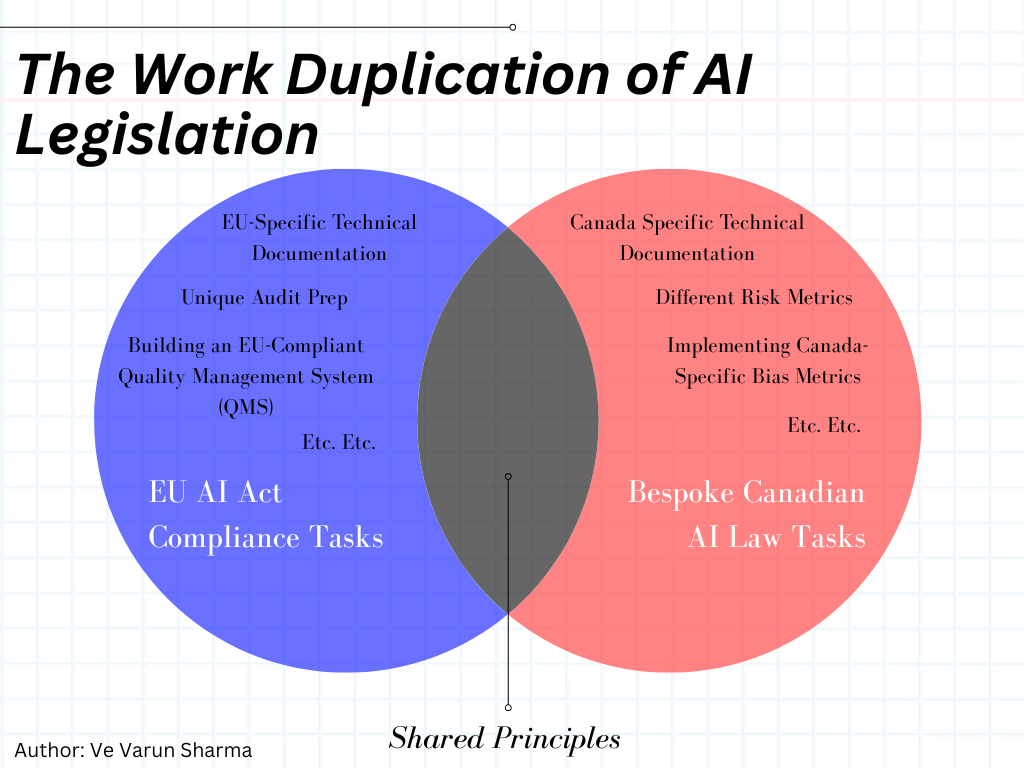
This is the very definition of a duplicative burden. It forces our most innovative companies to spend their limited resources building for two realities: one for Canada, and one for the world.
The Financial Impact of Future Non-Harmonized Canadian AI Legislation: A Comparison of Two Futures
A harmonized approach allows a startup to meet global standards with a single, manageable cost. A bespoke Canadian law would force a globally-minded startup to pay that cost and a duplicative Canadian premium, putting them at a permanent disadvantage.
Illustrative scenario comparison: The original “AIDA Impact Analysis: Two Plausible Outcomes” modeled harmonized and non-harmonized paths using rough estimates. It is not a forecast; Figure 3 visualizes the comparison.
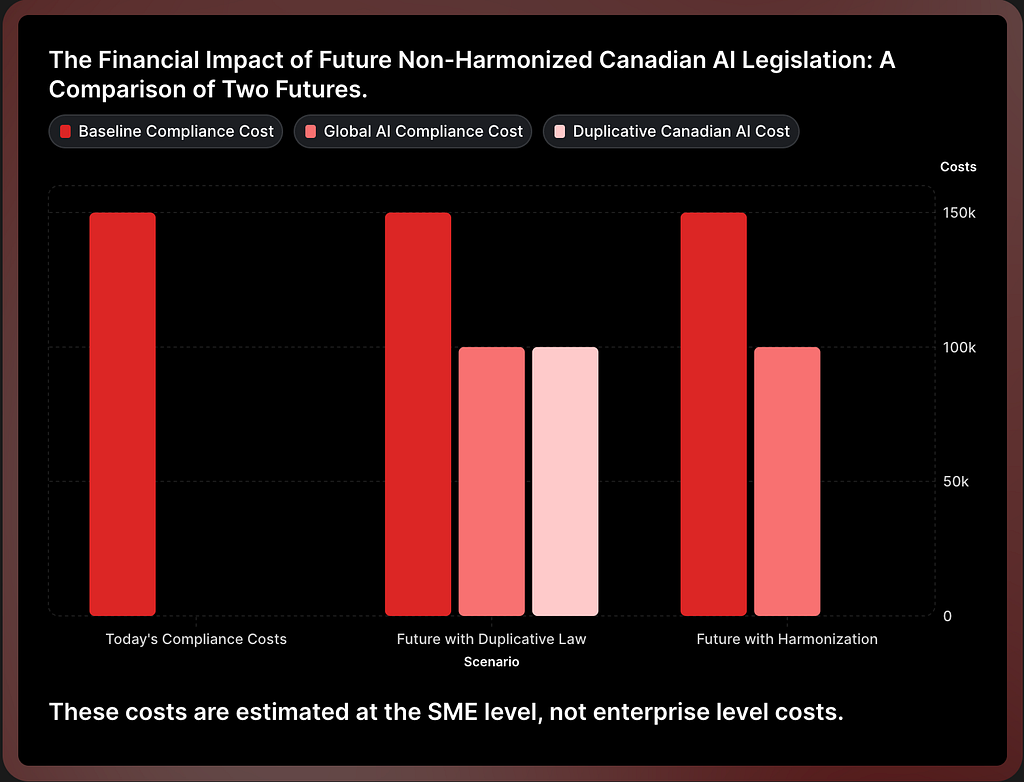
These are rough estimates and may be higher or lower depending on legislation, industry, and company size. They stack on top of the other compliance layers described above.
A Call for a Competitive Canada
My experience building an AI company has shown me that one of the most significant obstacles to our innovation is not the technology itself, but the friction we place in its path. That friction comes from the complex and costly web of compliance requirements that our most promising companies must navigate just to get to the starting line.
This is not an argument against regulation. It is an argument for cost-effective regulation that enables our innovators to compete and win. The government’s own Advisory Council on AI aims to boost Canadian productivity, yet saddling our most promising companies with unnecessary, duplicative costs is a direct contradiction of that goal.
Canada’s second chance at AI regulation is not about choosing between safety and innovation; it’s about choosing the smartest path to achieve both. A bespoke Canadian law risks becoming a more expensive and less competitive path.
A better path forward is international harmonization. It is the most effective and, critically, the most cost-efficient strategy to regulate AI.
I would strongly urge the government and its Advisory Council on AI to heed the lessons from AIDA’s demise. Cost-effectiveness and global competitiveness should be the pillars of our next AI legislation. By doing so, we can finally clear the path for our innovators, build that bridge to the world, and secure our place as a more productive and competitive AI nation.
Sources
- Parliament of Canada. Bill C-27, Digital Charter Implementation Act, 2022.
- Attard-Frost, B. (2025, January 17). The Death of Canada’s Artificial Intelligence and Data Act: What Happened, and What’s Next for AI Regulation in Canada? [Op-ed].
- Fraser, D., & Anderson Dykema, S. (2025, March 3). The Demise of AIDA: 5 Key Lessons. McInnes Cooper.
- Innovation, Science and Economic Development Canada. (2025, March 6). Canada moves toward safe and responsible artificial intelligence.
- Innovation, Science and Economic Development Canada. Advisory Council on Artificial Intelligence.
- European Commission. (2021). Study to support an impact assessment of regulatory requirements for artificial intelligence in Europe.